When considering hair restoration in Dallas, TX, understanding the difference between FUE or DHI hair transplant methods is essential for making an informed decision. Both techniques offer effective solutions for hair loss, but they differ in approach, execution, and specific benefits. Whether you’re experiencing male pattern baldness, thinning hair, or general hair loss, Moleno Hair Restoration can help you achieve the natural-looking results you desire.
Key Points
- FUE or DHI hair transplant procedures are minimally invasive methods that extract individual hair follicles from donor areas.
- DHI uses a specialized Choi pen to perform extraction and implantation in a single step.
- FUE involves creating recipient sites before placement, offering greater versatility for larger treatment areas.
- Both techniques deliver natural-looking results with minimal scarring compared to traditional strip methods.
- FUE is typically more cost-effective, widely available, and provides excellent long-term results for most hair restoration candidates in Dallas.
Understanding Modern Hair Transplant Methods
Hair transplantation has evolved dramatically over the past two decades. Today’s advanced techniques focus on natural-looking results, minimal downtime, and precise follicular placement. When evaluating FUE or DHI hair transplant options, it’s important to understand that both offer significant improvements over older methods, which involved removing a strip of scalp from the back of the head.
Modern hair restoration techniques prioritize individual follicle extraction, which means less visible scarring, faster healing, and results that blend with your existing hair. At Moleno Hair Restoration in Dallas, patients benefit from approaches that prioritize both aesthetic outcomes and patient comfort throughout the restoration journey.
What is a DHI Hair Transplant?
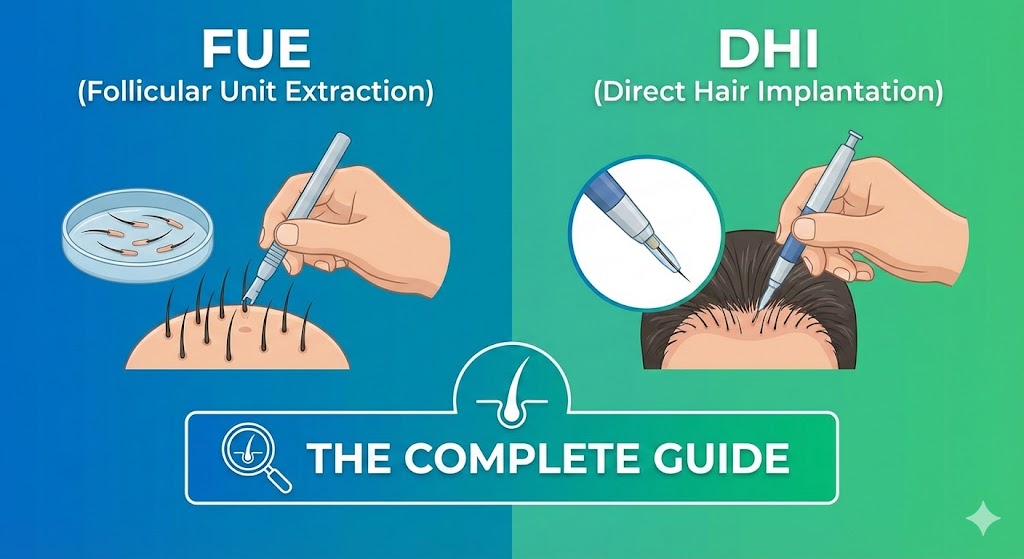
Direct Hair Implantation (DHI) uses a Choi Implanter Pen to extract and implant hair follicles in a single seamless motion. This specialized tool eliminates the need for pre-made incisions, allowing for direct placement and faster procedures. Unlike traditional methods, DHI usually requires less shaving, preserving more of your existing hairstyle. It also enables high-density implantation, placing follicles closer together for a fuller look—one of the key distinctions in the FUE or DHI hair transplant comparison.
What is a FUE Hair Transplant?
Follicular Unit Extraction (FUE hair transplant) is the gold standard for modern hair restoration in Dallas and across the U.S. This advanced technique extracts individual follicles from the donor area without a linear incision, resulting in minimal scarring and a quicker recovery compared to older methods.
During the procedure, follicles are removed one by one using a micro-punch tool, preserved in a special solution, and implanted into tiny, precisely planned recipient sites for a natural hairline and balanced density.
When comparing a FUE or DHI hair transplant, FUE offers exceptional versatility for treating both mild and advanced hair loss in men and women. It leaves only small, dot-like scars that are nearly invisible, even with short hair, and most patients can resume normal activities within a few days.
DHI vs FUE Results and Recovery
When comparing FUE or DHI hair transplant procedures, both offer excellent results when performed by experienced surgeons. Each technique focuses on achieving proper density, direction, and a realistic hairline.
The main difference lies in the approach. FUE involves creating recipient sites before placing grafts, allowing for precise control over angle and density. DHI uses an implanter pen to extract and implant follicles in one motion, which can streamline the process and reduce handling time.
Recovery for both FUE or DHI hair transplant methods is similar–minimally invasive with local anesthesia, little downtime, and mild temporary redness or swelling. Most patients can return to regular activities within a few days, avoiding intense exercise for about a week.
Why FUE Is the Preferred Choice for Many Patients
When comparing a FUE or DHI hair transplant, FUE remains the most widely practiced method in the U.S. thanks to its proven effectiveness and versatility. With years of clinical success, FUE offers reliable, long-term results and a strong safety record.
The technique works well for both small and large areas of hair loss and can even be used for body hair transplantation when scalp donor areas are limited. Because it doesn’t rely on specialized tools like the DHI implanter pen, FUE is typically more accessible and cost-effective for patients.
Its two-step process that creates recipient sites before implantation also allows for precise planning of hairline design, angle, and density. For anyone considering a FUE or DHI hair transplant, FUE continues to stand out as a trusted choice for lasting results.
Planning Your Next Steps with FUE
Understanding the difference between FUE and DHI hair transplant methods is just the first step.
During your consultation, several factors will be evaluated, including the extent of your hair loss, the quality and density of your donor area, your age and hair loss progression, your expectations and aesthetic goals, and your medical history.
At Moleno Hair, our Dallas hair restoration specialists take time to understand each patient’s concerns and goals. We provide honest assessments and clear explanations of what FUE can achieve for your specific case.
The FUE procedure typically takes 4-8 hours, depending on the number of grafts needed. Most patients find the experience comfortable, thanks to effective local anesthesia. Post-procedure care is straightforward, with detailed instructions provided to ensure optimal healing and graft survival.
Results develop gradually over several months. While transplanted hair initially sheds within a few weeks (a normal part of the process), new growth begins around the 3-4 month mark. By 6-8 months, significant improvement is visible, with full results apparent around 12 months post-procedure.
Choose between FUE or DHI Hair Transplants at Moleno Hair Restoration
While DHI offers some unique features with its specialized pen approach, FUE remains the proven, versatile, and widely preferred technique.
Ready to explore how FUE hair restoration can work for you? Contact Moleno Hair Restoration in Dallas to schedule a consultation with our experienced hair restoration specialists. Don’t let hair loss hold you back any longer–take control of your appearance and confidence today.
Frequently Asked Questions
How is DHI different from FUE hair transplant?
The main difference is in the implantation process. DHI uses a specialized Choi implanter pen that extracts and implants follicles in a single motion, while FUE involves a two-step process where recipient sites are created first, then follicles are implanted separately.
Is FUE more effective than DHI for hair restoration?
FUE has a longer track record with extensive clinical data supporting its long-term effectiveness and is more widely practiced with proven results. While DHI advocates claim certain advantages, there’s limited comparative research directly analyzing outcomes between the two methods.
Which procedure is less painful, a FUE or DHI hair transplant?
Both DHI and FUE hair transplants are minimally invasive procedures performed under local anesthesia. Most patients report little to no pain during either technique. Post-procedure discomfort is generally mild and manageable with over-the-counter pain medication.
Why do many clinics recommend FUE over DHI?
FUE is recommended more frequently because it has a proven track record spanning many years, works effectively for a wider range of cases, including larger treatment areas, doesn’t require specialized equipment like the Choi implanter pen, is more cost-effective for patients, and allows for strategic planning with its two-step process.
What should I expect during a FUE consultation?
During your FUE consultation, your surgeon will evaluate your hair loss pattern, examine the quality and density of your donor area, discuss your aesthetic goals and expectations, review your medical history, explain the FUE procedure in detail, and provide information about expected results and timeline. You’ll have the opportunity to ask questions, view before and after photos of previous patients, and receive a personalized treatment plan with cost estimates.